
Rizzler Sports Logo
Pricing
Learn

The Football Tryout Evaluation Form, Category by Category
A football tryout evaluation form scores every player on the same six categories: athleticism, football IQ, ball skills, blocking and tackling, routes and coverage, and effort and coachability. One scale, one form per player, combine numbers converted onto the same scale as the drill grades, totals ranked by position group at the end. This page gives you the full category list, a filled-out example from a 12U tryout, and how to fold 40 times and shuttle runs into the scored rows. For the blank printable, grab the tryout evaluation form template; for stations, staffing, and the planning-to-offers timeline, see how to run a football tryout. If you run the non-contact 5v5 game, the flag football version of this form adjusts the same categories for flag.
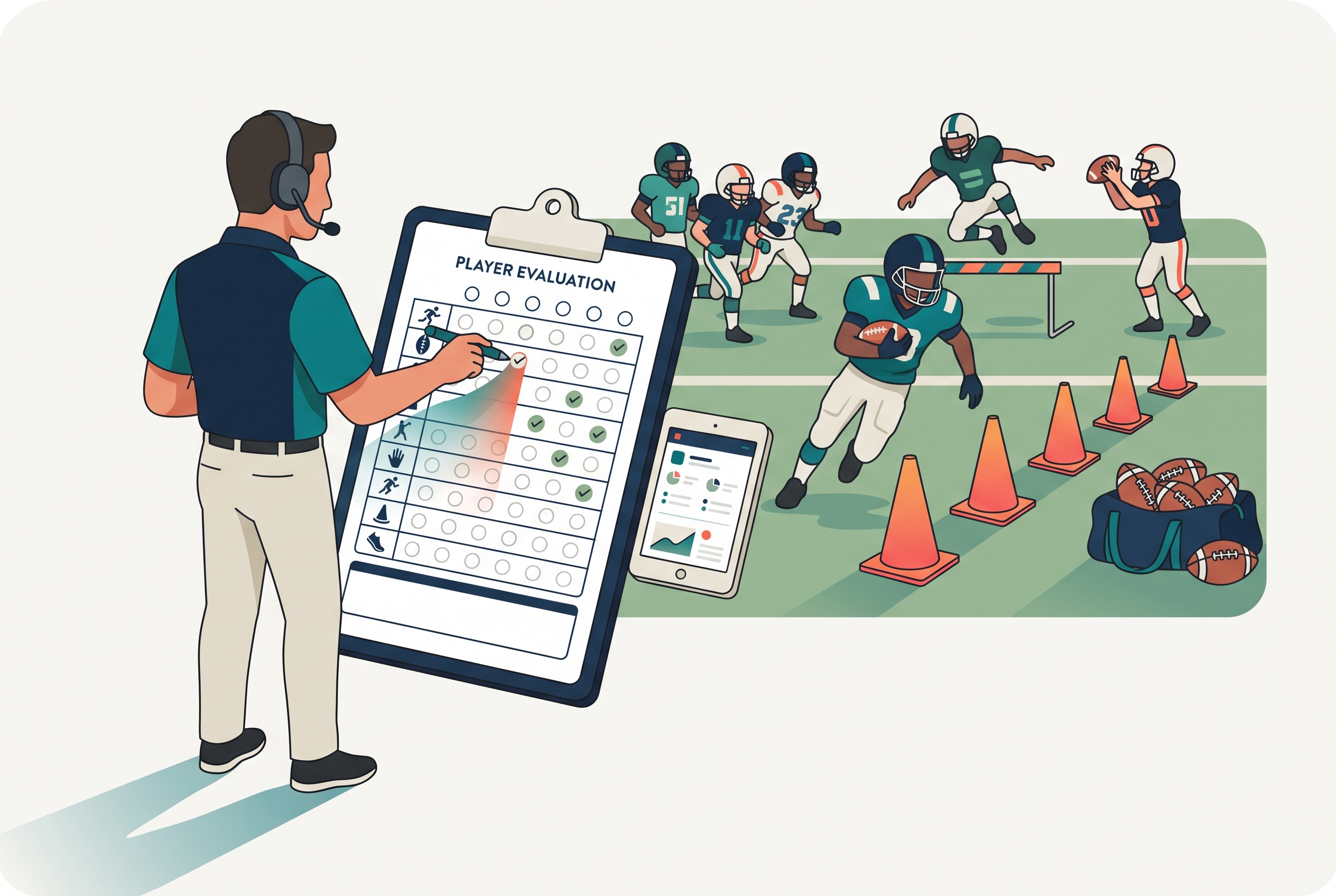
Football coach marking a tryout evaluation form on a clipboard while players run a cone drill behind him

The 6 categories that belong on a football tryout form

Score six categories: athleticism, football IQ, ball skills, blocking and tackling, routes and coverage, and effort and coachability. This is the same six-category structure Rizzler provisions as its default football evaluation template, and it is deliberately shorter than the nine-row baseball form. Football tryouts already produce a pile of measured numbers (the 40, the shuttle, the jumps), so the scored rows carry the judgment calls the stopwatch cannot make, and six rows is what a coach can actually mark between reps at a busy station.
CategorySkills to scoreHow to see it at a station
AthleticismSpeed, agility, strength40-yard dash, 5-10-5 shuttle or 3-cone, vertical or broad jump
Football IQPlay knowledge, decision makingInstall a simple play, then move the alignment; who lines up right?
Ball skillsThrowing accuracy, catching, ball securityHands drill at three heights; QB throws to set and moving targets
Blocking and tacklingBlocking, tacklingOne-on-one fit-and-drive reps; form tackling to a bag or shield
Routes and coverageRoute running, coverageRoute tree against air, then one-on-ones; man and zone drops
Effort and coachabilityMotor, coachabilityWatched all day: pace between reps, response to a correction
Not every player fills every row. A lineman may never run a route, and a quarterback may take no coverage reps. Leave the row blank rather than inventing a middle score; blanks keep the ranking honest, and totals should compare only the rows a player was actually scored on.

A filled-out example: what a scored form actually looks like

Here is a completed form for a 12U running back and linebacker candidate, scored 1 to 10 at the end of a one-day tryout. A worked example teaches the form faster than a blank one.
Player: #22, RB / LB candidate Group: 12U Session: 1 of 1
CategoryScore (1-10)Evaluator note
Athleticism8Second-best shuttle in the group; 40 middle of the pack
Football IQ7Lined up right after one install; called out the motion adjustment
Ball skills6Clean hands out of the backfield, double-clutched two high balls
Blocking and tackling8Best form tackler on the field; runs his feet through contact
Routes and coverage5Rounds his cuts; zone drops fine, loses the receiver in man
Effort and coachability9First in every line, fixed the cut angle on the very next rep
Total: 43 / 60 Projects: starting LB, rotational RB; route work is the offseason job
Two habits make a form like this hold up. Score immediately after the rep, not at the end of the station. And write notes in evidence language: "double-clutched two high balls" survives a phone call from a parent in a way "average hands" does not.

Fold the combine numbers into the scored rows
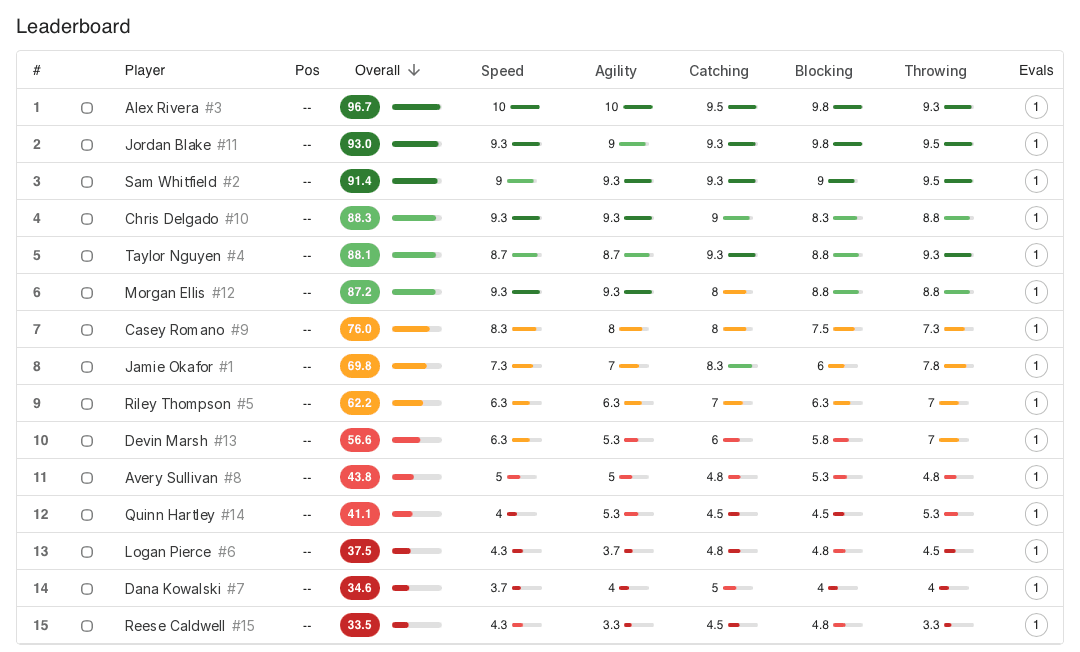
Convert measured results onto your scoring scale before you rank anyone. The cleanest method: time or measure every player, then grade each test on your scale by group, fastest times at the top of the scale, slowest at the bottom, and let the athleticism row hold the converted grade while the raw numbers live in the notes. A 40 time means nothing to a ranked list until it becomes a score that can sit next to a catching grade.
On paper use 1 to 5; in an app use 1 to 10. Five points is fast to mark with a pen between reps: 1 is well below age level, 3 is at level, 5 is exceptional. Digital scoring earns the wider scale because an 80-player field bunches badly on five points, and 1 to 10 converts straight to percentages for a clean ranked list. Whichever you use, anchor the contested categories before the tryout: for 12U route running, a 7 means sharp cuts at full speed with separation, a 5 means correct depth but rounded breaks, a 3 means the route tree is still being learned. Then have two coaches score the same three players in the first period and reconcile gaps before spreading out.

Ready to take your game to the next level?

Weight the form by position group

Use one form for everyone, then read it differently per position. Quarterbacks: throwing accuracy and football IQ effectively double, and the coverage skill goes unscored. Linemen: blocking, strength, and motor carry the evaluation, the routes and coverage row usually stays blank, and get-off quickness belongs in the notes. Skill positions: ball skills and routes and coverage do the sorting, with the 40 and shuttle breaking ties. Defensive backs and linebackers: tackling form plus coverage, and a great shuttle time matters more than a great 40.
At younger ages, shorten the measured tests (a 20-yard sprint is plenty at 8U) and expect the IQ row to measure teachability more than scheme knowledge. By 13U and up, the full six categories apply as written, and recorded combine numbers become worth keeping year over year, because measurements travel across seasons in a way opinion scores never do.

Two formats: one sheet per player, or the whole group on one page

Run the form in one of two formats, or both. The per-player sheet is the format above: one page per player, categories as rows, an evidence note beside every score. Use it at stations and for any player whose roster spot is a real discussion. The compact roster sheet flips the layout: one row per player, the six categories abbreviated across the top, a whole tryout group on a page or two. Use it when one coach is scanning a big field and wants position groups comparable at a glance.
Group: ______ Evaluator: ______ Date: ______ Score each cell 1 to 5; leave unattempted columns blank.
#PlayerAthIQBallBlk/TklRte/CovEffortTotalRec
1
2
3
4
5
Rec: Y = yes, B = bubble, N = no. Columns: Athleticism, Football IQ, Ball Skills, Blocking & Tackling, Routes & Coverage, Effort & Coachability.
The roster sheet gives up the notes column, so keep per-player sheets for the bubble players, where the note is what settles the staff discussion. The downloadable pack below includes both formats, plus a team sheet that totals each row automatically and a draft board that ranks the group from the scores.

From clipboard stack to depth chart

The form is the easy half. At a program tryout with a hundred-plus players and a two-dozen-coach panel, the hard half is collecting every sheet and turning them into one defensible list per position group before offers go out. On paper, that is a late night with a spreadsheet. Scored in Rizzler, every coach enters numbers at their station on a phone, the ranked board builds itself during the tryout, and offers go out and get tracked from the same place. The Team Tryouts workflow covers registration through offers for up to 300 players on the Club plan, with the football template pre-loaded and editable on Pro and Club if your program scores different categories. The same six-category template serves flag football too; the flag football version of this form covers what changes in the 5v5 game.

Frequently Asked Questions

What categories go on a football tryout evaluation form?

Six: athleticism, football IQ, ball skills, blocking and tackling, routes and coverage, and effort and coachability. Combine tests (the 40, shuttle, jumps) feed the athleticism row as converted scores, and position-specific rows stay blank for players who do not attempt them.

How do I score combine results like the 40-yard dash?

Record the raw time in the notes, then convert it onto your scoring scale by group: grade the fastest times at the top of the scale and the slowest at the bottom, within the same age group. The converted score ranks players; the raw number is the evidence behind it and is worth keeping year over year.

Do linemen and quarterbacks need different forms?

No. Use one form and leave unattempted rows blank: linemen typically skip routes and coverage, quarterbacks skip coverage reps. One form keeps every player comparable on the shared rows while the position rows sort the depth chart, and blanks keep totals honest when you rank within position groups.

What scale should I use to score a football tryout?

Use 1 to 5 on paper and 1 to 10 in an app, and define the middle before the first rep. Attach one sentence of evidence to each score: "double-clutched two high balls" ranks players and survives parent questions; "average hands" does neither.

Get the full template pack: player sheets, team sheet, draft board

The forms above are free to copy straight from this page. The pack adds the print-ready and editable versions of all of it: individual player sheets, a full team sheet that scores your whole roster on one page with totals that add themselves, and a draft board that ranks players from the scores. Use the form below, mention football tryout evaluation pack in the message box, and we will email the whole pack to you.

Talk to our team

Running football tryouts at scale? Let's talk.

Tell us about your club, league, or school and we'll come back within one business day with a walkthrough of registration, check-in, evaluations, invites, and offers in one place.

  • Cut tryout admin from days to minutes

  • Online registration and check-in for hundreds of players

  • Evaluate, rank, invite, and track offers in one place

Tell us about your program

4 fields · takes 30 seconds

Lands in the same inbox as the Help button · human response only