
Rizzler Sports Logo
Pricing
Learn

The Flag Football Tryout Evaluation Form, Built for the 5v5 Game

A flag football tryout evaluation form scores every player on six categories: athleticism, football IQ, ball skills, blocking and tackling scored as flag pulling, routes and coverage, and effort and coachability. What makes a flag form different from a tackle form is the weighting, not the skeleton: in the non-contact 5v5 game there are no linemen, so speed, ball skills, and a clean flag pull decide games, and the blocking skill barely matters. This page covers the categories, a filled-out example from a 10U tryout, and how to keep a whole evaluator crew scoring the same way. The blank printable lives at the tryout evaluation form template, the event logistics live at how to run a flag football tryout, and the tackle version of this form is at the football tryout evaluation form guide.
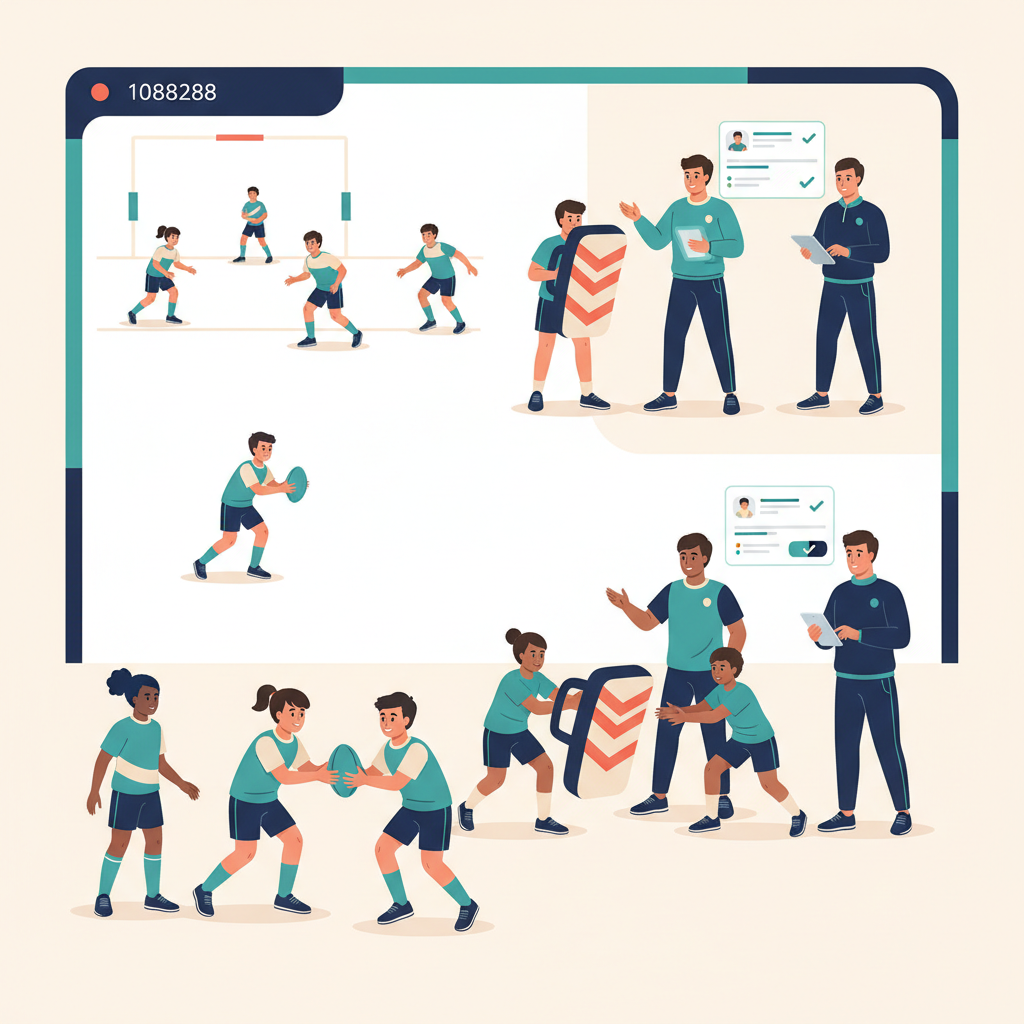
Flag football coach scoring a tryout evaluation form courtside as players run a flag-pulling drill

The 6 categories on a flag football tryout form

Score six categories: athleticism, football IQ, ball skills, blocking and tackling (scored as flag pulling), routes and coverage, and effort and coachability. Flag football shares Rizzler's default six-category football evaluation template, and that sharing is deliberate: the sport's skills are football skills. What changes is what you watch for inside each row, because the 5v5 game removes the line of scrimmage battle and plays everyone in space.
CategorySkills to scoreWhat to watch in the 5v5 game
AthleticismSpeed, agility, strength40 or shorter sprint, a box or zig-zag agility drill; speed carries flag
Football IQPlay knowledge, decision makingAlignment and route depth after one install; decisions on the move
Ball skillsThrowing accuracy, catching, ball securityQB throws to moving targets; hands at all heights; no exposed ball
Blocking and tacklingFlag pulling (tackling skill), blockingBreakdown, angle, clean pull instead of a grab; legal screen position
Routes and coverageRoute running, coverageSeparation on cuts; staying in phase with a receiver in open space
Effort and coachabilityMotor, coachabilityChases every flag, applies a correction on the next rep
Almost every player fills every row in flag. With five on the field and most athletes playing both ways, the two-way rows (routes on offense, coverage and flag pulling on defense) are exactly where rosters get sorted. If your league splits offense and defense specialists, leave the unattempted skill blank rather than guessing.

A filled-out example: what a scored form actually looks like

Here is a completed form for a 10U quarterback and rusher candidate, scored 1 to 10 across a one-day tryout. Reading a finished form teaches the system faster than instructions do.
Player: #5, QB / rusher candidate Group: 10U Session: 1 of 1
CategoryScore (1-10)Evaluator note
Athleticism7Won the agility drill; sprint times mid-group
Football IQ8Ran the option read correctly on the second install
Ball skills8Hit 7 of 10 moving targets; throws catchable balls on the run
Blocking and tackling6Clean pulls in the lane drill, grabs cloth in open space
Routes and coverage6Sharp on slants and outs, drifts deep routes
Effort and coachability9Fixed her release point on the next throw after one cue
Total: 44 / 60 Projects: starting QB; rusher rotation on defense
The notes are doing the real work. "Hit 7 of 10 moving targets" is evidence a staff can rank on and a parent can hear in February; "good arm" is neither. Train every evaluator to score right after the rep and write one short note per category.

Define the scale before the first snap
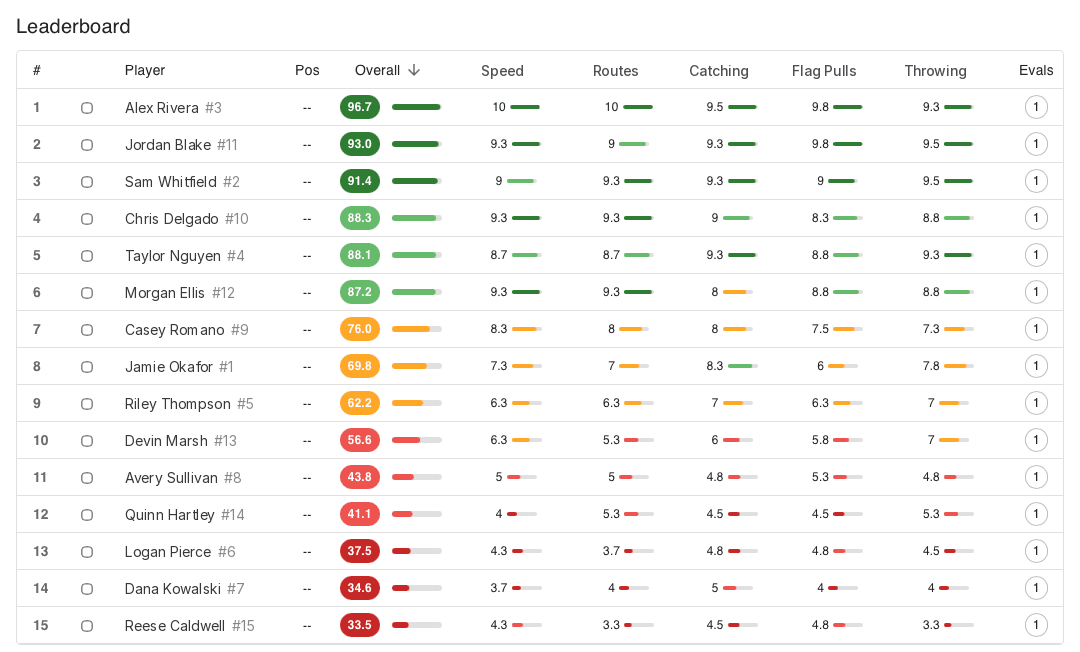
Use 1 to 5 on paper and 1 to 10 when scoring in an app. Five points is fast to mark with a pen while groups rotate; ten points separates a big field better when tapping is as fast as writing, and it converts straight to a percentage for ranking. Then anchor the categories coaches argue about most. For 10U flag pulling: a 7 means breaks down and makes clean pulls on a full-speed ball carrier; a 5 means pulls in confined drills but grabs cloth in space; a 3 means reaching, not running through the flag. Calibrate the crew on the first few players: two coaches score the same three kids, compare, and close any gap before spreading across fields. Scores drift as evaluators tire, so recalibrate after a lunch break on a two-session day.

Ready to take your game to the next level?

Adjust the form by age and league

At 6U and 8U, cut to four rows: athleticism, ball skills, flag pulling, and coachability, and score the throw as catchable or not rather than by placement. Most of the game at that age is chase and catch. By 10U the full six categories apply. At 12U and up, and in competitive or coed leagues, add discrimination inside the rows you already have: throwing on the run to a spot, route combinations, and defending the pitch on rusher plays. Many flag leagues run fall and spring seasons, so keep the scored forms; a spring form next to a fall form is the cheapest development tracker a program can have.

Two formats: one sheet per player, or the whole group on one page

Run the form in one of two formats, or both. The per-player sheet is the format above: one page per player, categories as rows, an evidence note beside every score. Use it at stations and for the players your last roster spots hinge on. The compact roster sheet flips the layout: one row per player, the six categories abbreviated across the top, a whole tryout group on a page or two. Use it when one coach is scanning several fields of 5v5 and wants every QB candidate comparable at a glance.
Group: ______ Evaluator: ______ Date: ______ Score each cell 1 to 5.
#PlayerAthIQBallFlagRte/CovEffortTotalRec
1
2
3
4
5
Rec: Y = yes, B = bubble, N = no. Columns: Athleticism, Football IQ, Ball Skills, Flag Pulling (Blocking & Tackling), Routes & Coverage, Effort & Coachability.
The roster sheet trades away the notes column, so pair it with per-player sheets for the bubble. The downloadable pack below includes both formats, plus a team sheet that totals each row automatically and a draft board that ranks the group from the scores, which is exactly the tool a flag league needs on draft night.

From clipboard to draft board

Flag leagues have a problem tackle programs mostly do not: the draft. A league tryout feeds a coach draft days later, which means every scored sheet has to become one ranked board the whole league trusts. On paper, that is an evening of transcription. Scored in Rizzler, each evaluator enters numbers on a phone at their station, the ranked list builds during the tryout, and the Team Tryouts workflow carries the same players from registration and check-in through evaluations and offers, up to 300 players on the Club plan. The six-category football template comes pre-loaded for flag football leagues and is editable on Pro and Club if your league scores different skills, and the paper pack's draft board mirrors what the ranked list gives you digitally.

Frequently Asked Questions

What should a flag football tryout evaluation form include?

Six categories: athleticism, football IQ, ball skills, flag pulling (the tackling skill in the shared football template), routes and coverage, and effort and coachability. Weight speed, ball skills, and flag pulling heaviest; the 5v5 game has no linemen, so blocking barely factors into roster decisions.

How is a flag football form different from a tackle football form?

Same six-category skeleton, different weighting and contents. Flag scores the tackling skill as flag pulling, drops line play almost entirely, and leans harder on speed, route running, and quarterback accuracy because every player operates in space. A tackle form used unchanged at a flag tryout over-values size and under-values the quick kid who pulls every flag.

How do I run tryout scores into a league draft?

Total each player's scored rows, rank within the age group, and put the ranked list on a draft board with round and pick columns. Averaging multiple evaluators' scores per player first makes the board defensible. The downloadable pack on this page includes a draft board that builds the ranking from the team sheet's totals automatically.

What scale works best for flag football tryouts?

1 to 5 on paper, 1 to 10 in an app. Define the middle number per category before the tryout, write one evidence note per score, and calibrate evaluator pairs on the first few players. Consistency across the crew matters more than which scale you pick.

Get the full template pack: player sheets, team sheet, draft board

The forms above are free to copy straight from this page. The pack adds the print-ready and editable versions of all of it: individual player sheets, a full team sheet that scores your whole roster on one page with totals that add themselves, and a draft board that ranks players from the scores. Use the form below, mention flag football tryout evaluation pack in the message box, and we will email the whole pack to you.

Talk to our team

Running flag football tryouts at scale? Let's talk.

Tell us about your club, league, or school and we'll come back within one business day with a walkthrough of registration, check-in, evaluations, invites, and offers in one place.

  • Cut tryout admin from days to minutes

  • Online registration and check-in for hundreds of players

  • Evaluate, rank, invite, and track offers in one place

Tell us about your program

4 fields · takes 30 seconds

Lands in the same inbox as the Help button · human response only