
Volleyball
What Counts as a Kill in Volleyball (and What Doesn't)
A kill in volleyball is an attack that ends the rally immediately in the attacker's favor: the ball hits the opponent's floor, the opponent's first touch cannot be kept in play, or the attack forces a blocking fault. Not every spike is a kill, and not every kill is a spike. Here is the exact definition scorekeepers use, the edge cases that confuse youth benches, and what kill numbers actually look like at each level.
The Definition, Precisely
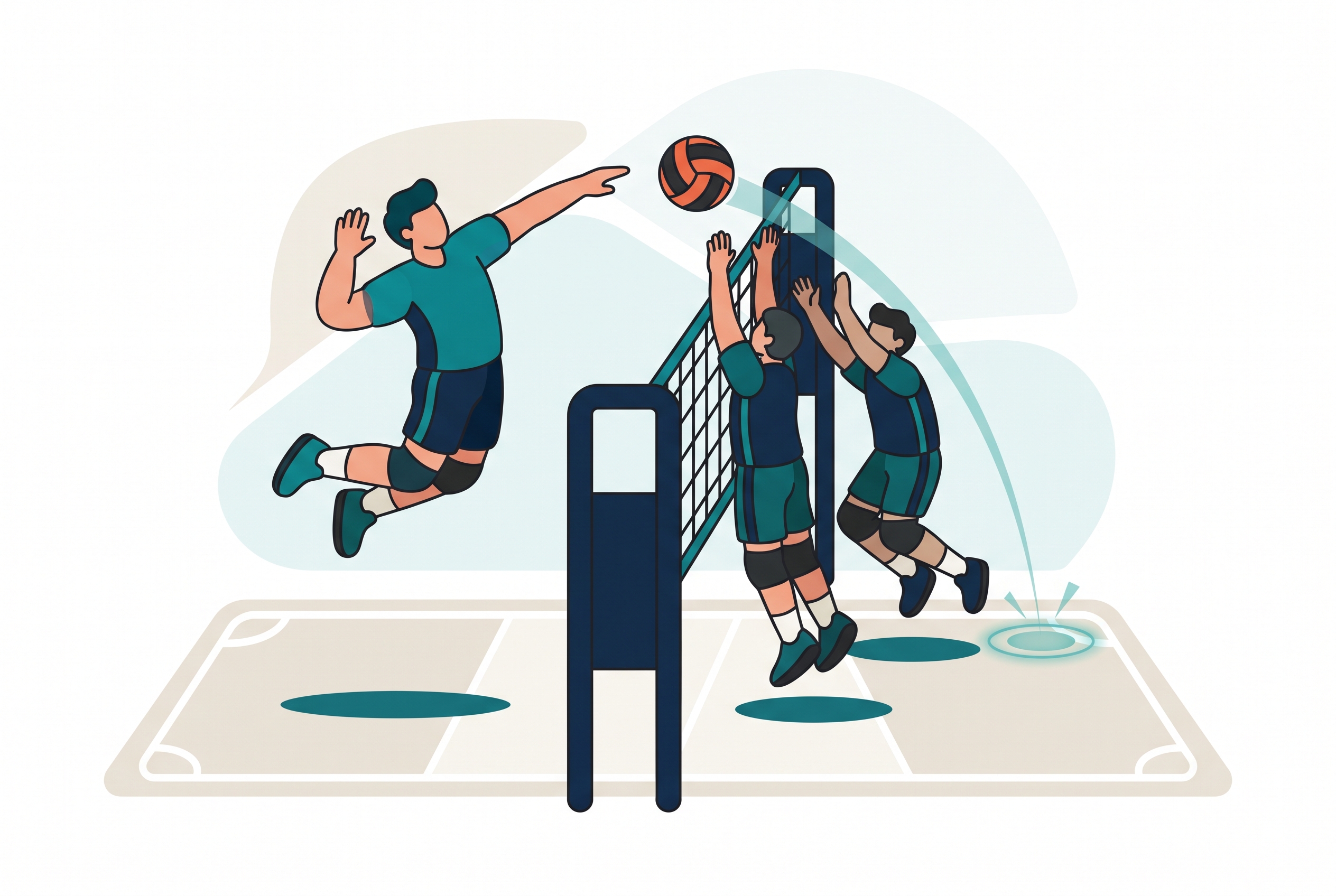
Statisticians credit a kill when a player's attack attempt leads directly to a point. "Directly" is the load-bearing word, and it covers exactly three outcomes: the attacked ball lands in bounds on the opponent's floor, the opponent touches the ball but cannot make a playable next contact (a shanked dig counts here), or the attack forces the block into a fault such as reaching into the net. If any of those happen, the attacker gets a kill and, under rally scoring, the team gets the point.
Three things follow from the definition that surprise new scorekeepers. A tip counts: a soft one-hand dink that lands is as much a kill as a thunderous swing, because the statistic measures outcome, not violence. A block does not count: when a defender stuffs the ball back to the floor, that is a block for the defender, not a kill for anyone. And an opponent's error without an attack is not a kill either: if the other team simply passes a free ball out of bounds, nobody gets attack credit.
Kill vs Attack vs Attack Error
Every swing (plus tips and down-balls sent over on purpose) is an attack attempt, abbreviated TA. Each attempt ends one of three ways:
| Outcome | Scored as | Examples |
|---|---|---|
| Ends the rally for your team | Kill (K) | Floor hit, unplayable dig, forced blocking fault |
| Ends the rally for the opponent | Attack error (E) | Hit out or into the net, stuff-blocked to your floor, back-row or antenna fault |
| Rally continues | Zero attack | Dug cleanly, controlled by the block, kept in play |
Those three buckets are the entire arithmetic of attacking. Kills alone reward volume; a hitter who swings 40 times can pile up kills while donating just as many errors. That is why the companion number, hitting percentage, subtracts errors and divides by attempts, and why coaches read the two together.
What Good Kill Numbers Look Like
Kills are usually reported per set (K/S). Honest reference points, blending NCAA box scores with what strong club and school teams actually produce:
| Level | Strong outside hitter | Team, per set |
|---|---|---|
| Middle school / 13U club | 1.5 to 2.5 K/S | 6 to 9 |
| JV / 15U club | 2 to 3 K/S | 8 to 11 |
| Varsity / 17U-18U club | 2.5 to 3.5 K/S | 10 to 13 |
| NCAA Division I | 3.5 to 4.5+ K/S | 12 to 14 |
Two cautions for youth benches. First, at younger ages many "kills" are really receive errors wearing a costume: an easy roll shot lands because nobody moved. Charting attempts and errors alongside kills, rather than kills alone, keeps the story honest. Second, kill counts are a team product: a hitter's kills depend on the passes that reached target and the setter's delivery, which is why serve-receive charting on a 3-2-1 scale (the same scale used in our drill library) belongs next to attack stats in any season log.
The Edge Cases Scorekeepers Argue About
The ball that hits the blocker's hands and lands out of bounds. Kill. The touch makes it the defense's ball; landing unplayed ends the rally in the attacker's favor.
The overpass the opposing setter dumps on. If the second contact is an intentional attack (a setter dump) that ends the rally, it is a kill for the setter. Accidental overpasses that dribble over and die are usually charted as opponent errors, not kills, though youth scorekeepers are inconsistent here; pick a convention and keep it all season.
Back-row attacks. A legal back-row attack that ends the rally is an ordinary kill. An illegal one (back-row player attacking above net height in front of the attack line) is an attack error, and it is one of the alignment-adjacent rules covered in our rotations guide, because attack rights come from rotation position.
A serve ace. Never a kill. Serving statistics are their own family; kills belong only to attack attempts after the serve.
Tracking Kills for a Youth Team Without Losing Your Mind
You do not need broadcast-grade software to get real value. A paper chart with one row per player and three tally columns (K, E, TA) captures everything the math needs; our printable stat sheet is laid out exactly this way, and the rotation sheet beside it on the clipboard tells you who was front row when the swing happened. Where kills fit among the rest of the box score is mapped in the volleyball stats guide. Tally at set breaks, not mid-rally, and total after the match.
What the tallies cannot tell you is why. A hitter with falling kill numbers might be approaching late, contacting low, or choosing shots badly, and that diagnosis is a skills question, not a stats question. This is where Rizzler closes the loop for volleyball teams: score the underlying skills with a structured player evaluation (the volleyball template's attacking category scores approach and timing, power, and shot selection separately), assign the fixing work as drills through Rizzler Reps, and re-assess mid-season to see whether the skill moved with the stat. The number tells you where to look; the evaluation tells you what to coach; the attacking drills are what you coach with.
Frequently Asked Questions
What counts as a kill in volleyball?
Any attack attempt that ends the rally in the attacker's favor: the ball lands on the opponent's floor, the opponent's first touch cannot be returned to play, or the attack forces a blocking fault. Tips and dumps count; blocks and opponent free-ball errors do not.
Is a block a kill?
No. A point scored by the block belongs to blocking statistics. A kill requires an attack attempt by the hitter; if the defense stuffs that attempt, the hitter is charged an attack error and the blocker earns the block.
Is an ace a kill?
No. An ace is a serving statistic. Kills are credited only on attack attempts during the rally, after serve receive.
What is a good number of kills per set?
Around 2 per set marks a strong middle school outside hitter, 2.5 to 3.5 a strong varsity hitter, and 3.5 or more an elite college attacker. Read kills next to errors and attempts, because kills alone reward swinging often rather than swinging well.
What is the difference between a kill and a hitting percentage?
Kills count rally-ending attacks; hitting percentage is (kills minus errors) divided by total attempts, a rate that punishes errors and rewards efficiency. A hitter can lead the team in kills and still hurt it if errors keep pace. The formula, worked examples, and level benchmarks are in our hitting percentage guide.
How do you calculate kill percentage in volleyball?
Kill percentage is kills divided by total attack attempts, so 12 kills on 30 swings is .400 (40 percent). It ignores errors, which is why coaches lean on hitting percentage instead: that formula subtracts errors before dividing, so the same hitter with 5 errors is hitting .233.
Talk to our team
Want to spend more time coaching and less time with paperwork? Let's talk.
Tell us about your team and we'll show you how to plan games, set lineups, run the schedule, and develop players in one place, so you spend the season coaching instead of chasing admin.
Less admin, more coaching
Plan games, set lineups, and track the season in one place
Keep every family in the loop automatically
Tell us about your program
4 fields · takes 30 seconds
Lands in the same inbox as the Help button · human response only
Read Next
Youth Baseball Tournament Planning Checklist
BlogBest Apps for Travel Baseball Coaches in 2026
LearnTournament Planning for 13U-14U Baseball
BlogHow to Run a Football Tryout: A Coach's Step-by-Step Guide
LearnMiddle School Volleyball Drills: A Full Practice's Worth
VolleyballHow Does In-Game Scoring Work in Rizzler?
FAQ