

The Baseball Tryout Evaluation Form, Category by Category
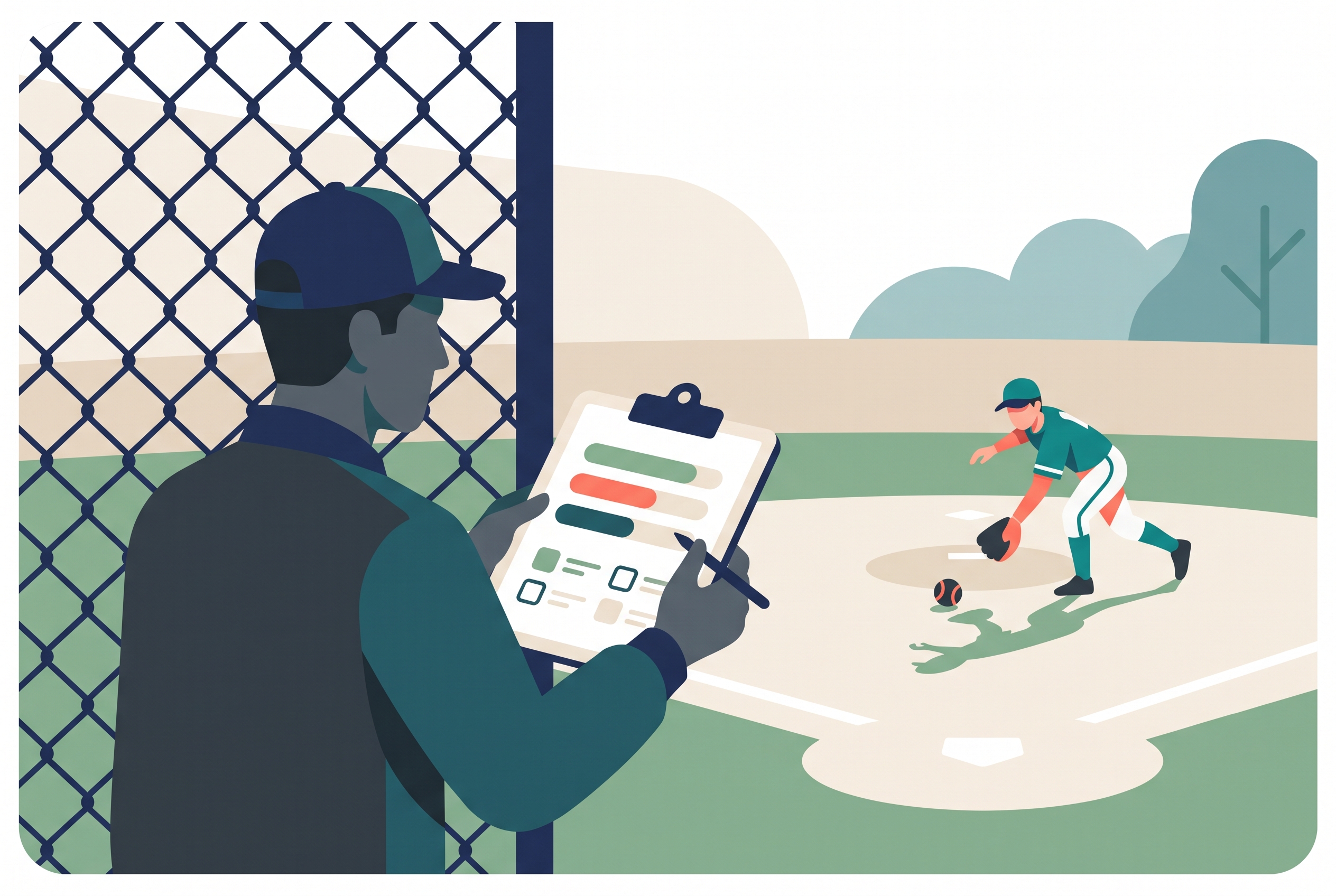
The 9 categories that belong on a baseball tryout form
| Category | Skills to score | How to see it at a station |
|---|---|---|
| Athleticism | Speed, footwork | Timed run; footwork during infield reps |
| Baseball IQ | Rules knowledge, decision making | Situational rounds: where's the play with a runner on second? |
| Throwing | Strength, accuracy | Position throws: SS to first, OF to third |
| Catching | Mechanics, reliability | Soft hands or fights the ball; drops under fatigue |
| Infield | Mechanics, range | 5 grounders at, 3 to each side; glove-side backhand |
| Outfield | Read on hits, range | First-step read off live fungo, not machine-fed |
| Pitching | Mechanics, accuracy, composure | 15-pitch bullpen; strike percentage and reaction to a miss |
| Catcher skills | Blocking, catcher IQ, throwdowns | Block series in gear; glove-to-glove time to second |
| Hitting | Contact, power | 8 to 10 swings of front toss or live arm, not tee only |
A filled-out example: what a scored form actually looks like
| Category | Score (1-10) | Evaluator note |
|---|---|---|
| Athleticism | 7 | Second-fastest home-to-first in his group |
| Baseball IQ | 8 | Called the cut man before the coach did |
| Throwing | 6 | Accurate across the diamond, arm strength average |
| Catching | 7 | Quiet hands on short hops |
| Infield | 8 | Range both sides, clean exchange, feet always moving |
| Outfield | 4 | Late reads, drifted on two of five |
| Pitching | 6 | 9 of 15 strikes, composed after a barrel |
| Catcher skills | (blank) | Did not try out behind the plate |
| Hitting | 5 | Contact-first, line drives to the middle, power not there yet |
Define the scale before the first ground ball
The scoring rubric: what each number looks like
| Score | What it means | What that athlete looks like |
|---|---|---|
| 1 | Well below the level; significant gaps | A clear developmental need at this station today. Mechanics break down on routine reps |
| 2 | Below the level; heavy development needed | Flashes of the skill, but inconsistent even on routine reps |
| 3 | At the level; playable now | Age-appropriate and roster-viable. Handles the routine play reliably |
| 4 | Above the level; immediate impact | Above the pack for this age group, on this day. Routine plays are automatic, hard plays are competitive |
| 5 | Rare for the age group | Elite relative to the tryout pool. By design you should see very few of these on a full sheet |
Seen in the timed run, footwork during fielding reps, and the bases.
| Score | What it looks like: Athleticism |
|---|---|
| 1 | Slow first step and heavy feet in fielding reps. Hesitates out of the box and watches the ball, not the coaches. |
| 2 | Average runner with a slow start. Footwork breaks down when the drill speeds up. Rounds bases wide. |
| 3 | Runs hard every time, mid-pack on the timed run. Feet stay under them through fielding reps. Rounds bases properly. |
| 4 | Quick first step and above-average times. Footwork holds up late in the session. Takes the extra base when it is there. |
| 5 | Fastest tier of the group. Explosive first step in every drill. Creates pressure on the bases. |
Seen in situational rounds: where is the play with a runner on second?
| Score | What it looks like: Baseball IQ |
|---|---|
| 1 | Does not know the count or the outs. Throws to the wrong base. Misses cutoffs. |
| 2 | Knows the basics but forgets in the moment. Late on backups. |
| 3 | Knows the situation. Hits cutoffs. Backs up plays. |
| 4 | Anticipates the play before it happens. Communicates with teammates. |
| 5 | Thinks an inning ahead. Directs teammates. Makes the smart play under pressure. |
Seen in position throws: shortstop to first, outfield to third.
| Score | What it looks like: Throwing |
|---|---|
| 1 | Ball dies before the target. Throws well off line. All arm, no body. |
| 2 | Gets it there but weak. Accurate short, wild on longer throws. |
| 3 | Reaches the target on one hop from the outfield. Accurate on routine plays. |
| 4 | Strong throws with carry. Quick release. Accurate under pressure. |
| 5 | Ball explodes out of the hand. On line from anywhere on the field. Throws out runners. |
Seen across every station: soft hands or fights the ball, drops under fatigue.
| Score | What it looks like: Catching |
|---|---|
| 1 | Fights the ball. Catches against the body. Drops routine throws. |
| 2 | Catches what is at them, but the hands are loud. Drops show up as the station runs long. |
| 3 | Soft hands on routine throws. Reliable through the whole station. |
| 4 | Quiet hands on short hops and off-line throws. No drops under fatigue. |
| 5 | Catches everything catchable. Turns bad throws into outs. |
Seen on grounders at, to each side, and the glove-side backhand.
| Score | What it looks like: Infield |
|---|---|
| 1 | Waits for the ball to come. Stiff lower half. Traps the ball against the body. |
| 2 | Fields balls hit at them. Bobbles the transfer. Will not charge slow rollers. |
| 3 | Gets to balls two or three steps either side. Catches out front, clean exchange on routine plays. |
| 4 | Good first step, ranges both directions. Soft hands on bad hops, the backhand is reliable. |
| 5 | Makes plays others cannot reach. Reads hops early. Smooth on every ball. |
Seen on first-step reads off live fungo, not machine-fed.
| Score | What it looks like: Outfield |
|---|---|
| 1 | Freezes on contact. Misreads most balls off the bat. Catches are an adventure. |
| 2 | Drifts instead of running routes. Handles balls hit at them, late on balls over either shoulder. |
| 3 | Solid first-step read off live contact. Direct routes on routine balls, secure catches. |
| 4 | Good reads and efficient routes in both directions. Runs down balls in the gap. |
| 5 | Elite first-step read. Takes away extra-base hits. Every catchable ball gets caught. |
Seen in a 15-pitch bullpen: strike percentage and the reaction to a miss.
| Score | What it looks like: Pitching |
|---|---|
| 1 | Cannot find the zone and the bullpen runs long. Mechanics change pitch to pitch. |
| 2 | Strikes come in streaks. Fastball only. Rattled by hard contact. |
| 3 | Throws strikes with the fastball. Repeats the delivery on most pitches. |
| 4 | Strikes with two pitches. Stays composed after hard contact. |
| 5 | Commands both sides of the plate with more than one pitch. Attacks every hitter. |
Seen in a block series in gear and glove-to-glove time to second.
| Score | What it looks like: Catcher Skills |
|---|---|
| 1 | Turns the head on blocks and balls get through. Throwdowns sail. |
| 2 | Blocks balls in front but not to the sides. Slow transfer on throwdowns. |
| 3 | Keeps blockable balls in front. Accurate throwdowns with an average release. |
| 4 | Blocks and recovers quickly to either side. Quick transfer, on-target throwdowns. |
| 5 | Nothing gets through. Glove-to-glove times that change the running game. Runs the infield. |
Seen in 8 to 10 swings of front toss or live arm, not tee only.
| Score | What it looks like: Hitting |
|---|---|
| 1 | Steps away from the pitch. Head pulls out. Swing is late or early. |
| 2 | Off-balance swing. Weak contact to the pull side. Chases pitches out of the zone. |
| 3 | Level swing, stays balanced. Solid contact on strikes. |
| 4 | Quick hands. Drives the ball to all fields. Does not chase. |
| 5 | Barrels the ball. Adjusts to different pitch speeds. Still dangerous with two strikes. |
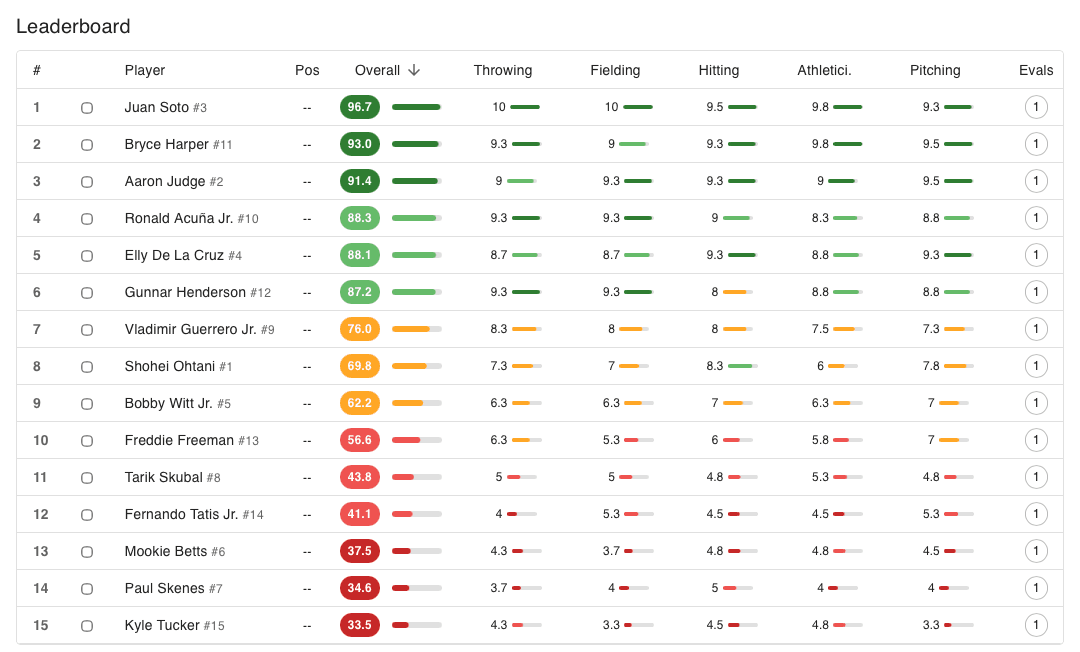
Adjust the form by age
Two formats: one sheet per player, or the whole group on one page
| # | Player | Ath | IQ | Thr | Cat | IF | OF | Pit | C-Sk | Hit | Total | Rec |
|---|---|---|---|---|---|---|---|---|---|---|---|---|
| 1 | ||||||||||||
| 2 | ||||||||||||
| 3 | ||||||||||||
| 4 | ||||||||||||
| 5 |
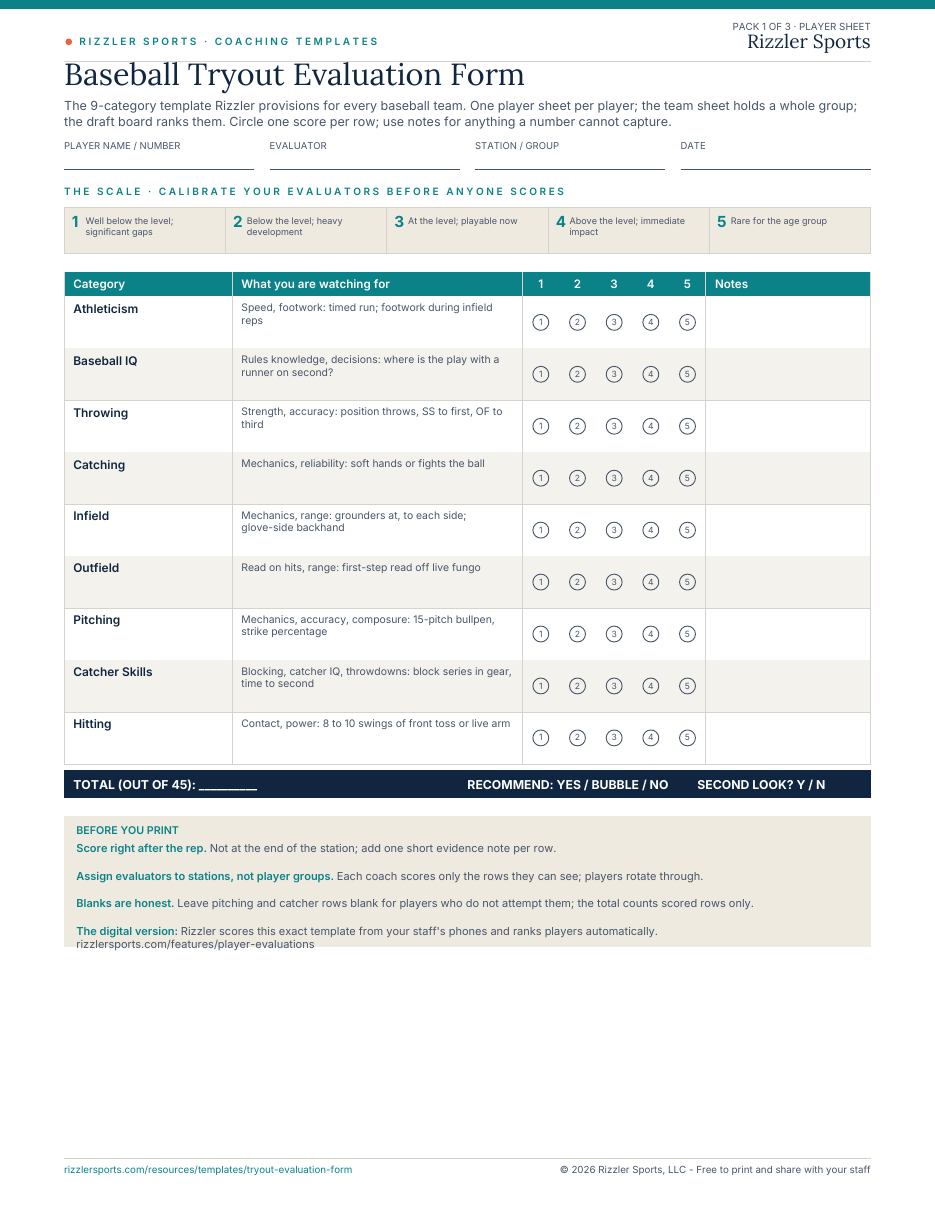
From clipboard stack to ranked list
Frequently Asked Questions
What categories go on a baseball tryout evaluation form?
What scale should I use to score a baseball tryout?
Do pitchers and position players need separate forms?
How do I keep 15 evaluators scoring consistently?
Get the full template pack: player sheets, team sheet, draft board
The forms above are free to copy straight from this page. The pack adds the print-ready and editable versions of all of it: individual player sheets, a full team sheet that scores your whole roster on one page with totals that add themselves, and a draft board that ranks players from the scores. Use the form below, mention baseball tryout evaluation pack in the message box, and we will email the whole pack to you.
Talk to our team
Running baseball tryouts at scale? Let's talk.
Tell us about your club, league, or school and we'll come back within one business day with a walkthrough of registration, check-in, evaluations, invites, and offers in one place.
Cut tryout admin from days to minutes
Online registration and check-in for hundreds of players
Evaluate, rank, invite, and track offers in one place
Tell us about your program
4 fields · takes 30 seconds
Lands in the same inbox as the Help button · human response only