
Learn
How to Create a Baseball Lineup
Creating a baseball lineup means assigning every player on your roster to a batting order position and a fielding position for each inning of the game. A good lineup balances competitiveness with player development and playing time fairness while staying within your league's rules. Here's how to do it from scratch, whether you're a first-year coach or a veteran looking for a better system.
Step 1: Know Your Roster
Before you touch a lineup card, understand what you're working with:
- How many players do you have? 10 players means simple rotations. 15 players means more complex substitution planning.
- What positions can each player play? Most youth players should play at least 3-4 positions over a season. Right now, you need to know their primary and secondary positions.
- Who can pitch? Who can catch? These are the two constraint-heavy positions. Pitchers have pitch count limits. Catchers have catcher-to-pitcher restrictions. Know who's eligible before you start.
- Is anyone unavailable? Injuries, rest-day restrictions from the last game, or kids who can't make it.
Write all of this down or have it in your coaching app. Don't try to hold it in your head.
Step 2: Set Your Batting Order
The batting order is the sequence your players will bat in throughout the game. In a standard 9-player batting order, only your 9 fielders bat. In a continuous batting order (common in rec leagues), your entire roster bats through.
Batting order fundamentals:
| Position in Order | Traditional Role | What to Look For |
|---|---|---|
| 1 (Leadoff) | Get on base | High OBP, good speed, patient hitter |
| 2 | Move runners, solid contact | Contact hitter, can bunt, low strikeout rate |
| 3 | Best all-around hitter | High AVG, good power, high OBP |
| 4 (Cleanup) | Drive in runs | Power, extra-base hits |
| 5 | Secondary power | Similar to #4, slightly less consistent |
| 6-7 | Solid contact | Reliable hitters, fill the middle |
| 8-9 | Developing hitters / second leadoff | At 8: less experienced hitters. At 9 in continuous order: treat as a second leadoff spot |
At the youth level, these roles are flexible. An 8U lineup doesn't need a "cleanup hitter." A 12U rec league lineup should prioritize fair distribution across batting order positions over the season more than optimizing each individual game. Batting order strategies by age →
For a faster approach, use Rizzler's free lineup generator or AI Batting Order (Coach and Club plans) to generate a starting point, then adjust.
Step 3: Assign Fielding Positions by Inning
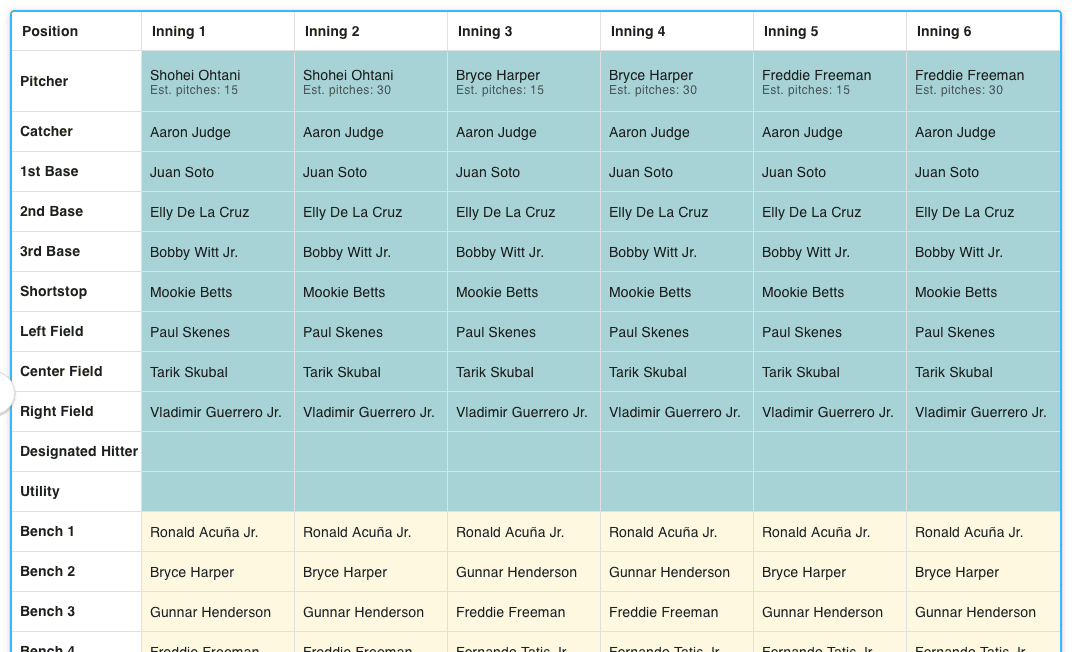
A fielding rotation maps out which player plays which position in each inning. For a 6-inning game with 12 players, this means filling 54 slots (9 positions × 6 innings) with 12 players, which means some players will sit out some innings.
Guidelines for fielding rotations:
- Every player should play at least the minimum required by your league. Minimum play rules vary by league →
- Rotate players through different positions. Don't park the same kid at right field for the entire season. Youth development requires exposure to multiple positions. Fielding rotation strategies →
- Keep pitchers off the infield after pitching. An arm that just threw 50 pitches shouldn't go to shortstop where they'll make 15 more hard throws.
- Protect catcher innings. If you might need a player to pitch later, limit their catching innings to stay clear of the catcher-to-pitcher rule.
Step 4: Set Your Pitching Plan
Decide who's pitching, approximately how many innings or pitches they'll throw, and who's available in relief.
- Check pitch count limits for your league and age group
- Check rest-day status from previous games
- Check catcher-to-pitcher eligibility
- Plan for a target pitch count, not the maximum (leave room for adjustment)
If you're playing in a tournament, your pitching plan for this game should be part of a larger weekend plan. How to plan pitching across a tournament →
Step 5: Check the Rules
Before you finalize, verify your lineup against your league's rules:
- ✅ Pitch count limits respected
- ✅ Rest-day restrictions from prior games cleared
- ✅ Catcher-to-pitcher rule not violated
- ✅ Minimum play requirements met (every player meets their minimum innings)
- ✅ Substitution rules followed (re-entry rules vary by league)
- ✅ Batting order rules followed (continuous order if required)
Rizzler automatically checks the first four (pitch counts, rest days, catcher-to-pitcher eligibility, and minimum play) as you build your game plan and alerts you before you save a violation. Substitution and batting order rules stay on your checklist. If you're building on paper, double-check everything manually.
Step 6: Share and Execute
Get the lineup to your assistant coaches before the game. Whether that's sharing it through Rizzler (where it shows up on their phones automatically), texting a screenshot, or handing them a printed lineup card, make sure everyone is on the same page before first pitch.
During the game, adjustments will happen. A player gets hurt. A pitcher is struggling. You need to make a defensive change. When changes happen, update the rest of the game so you don't lose track of who's playing where in later innings.
Rizzler's game planning view handles this for you: make a change in the current inning and it adjusts downstream innings to maintain your rotation. On paper, you'll need to recalculate manually.

The Rizzler Way (Under 10 Minutes)
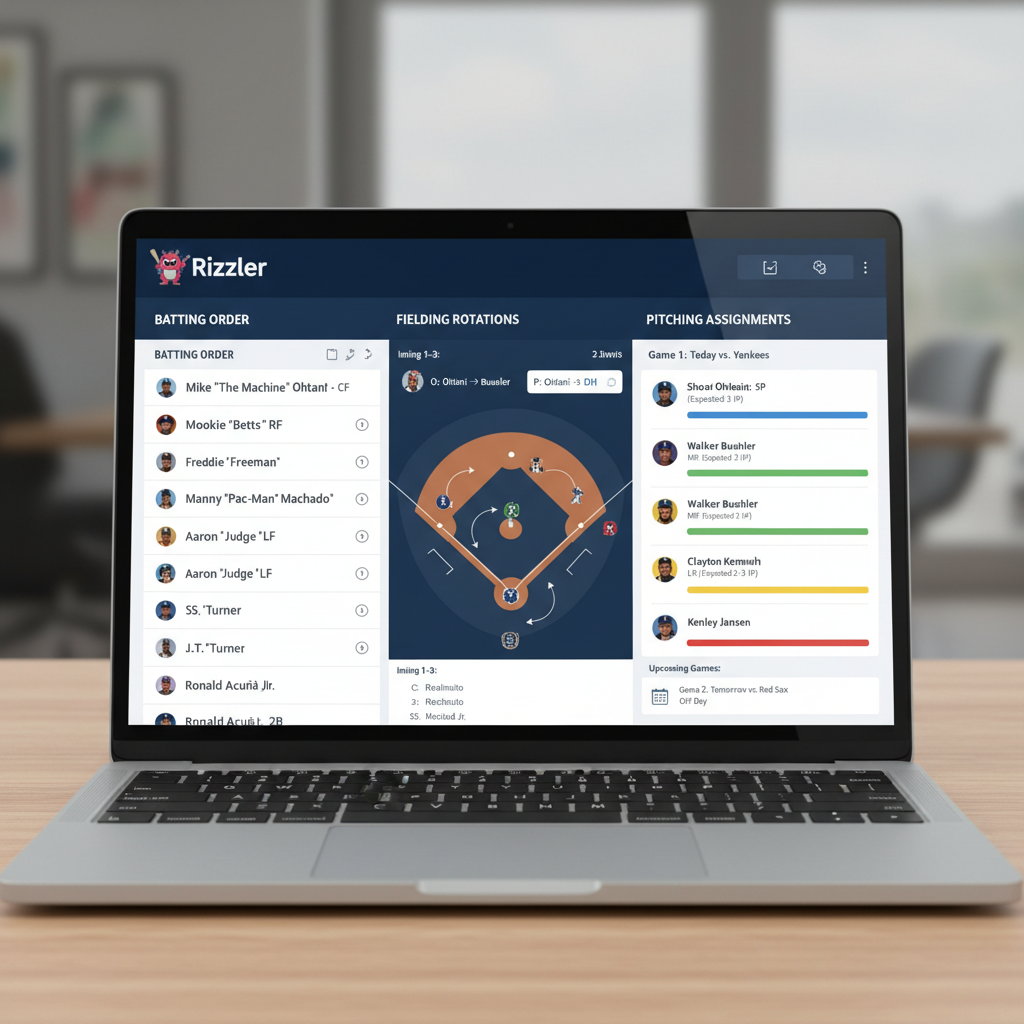
- Open Rizzler on your laptop
- Navigate to your next game
- Drag players into the batting order (or click "AI Batting Order" on Coach)
- Assign fielding positions per inning (or click "AI Fielding Positions" on Coach)
- Set your pitcher and pitch count target
- Rizzler checks pitch counts, rest days, catcher-to-pitcher eligibility, and minimum play; fix any flagged issues
- Save. Done. It's on your phone for game day.
Frequently Asked Questions
How many batters are in a baseball lineup?
A standard baseball lineup has 9 batters, one for each fielding position. In a continuous batting order, common in rec and Little League, every player on the roster bats, so a 12-player roster means 12 batters. In either format, only 9 players are on defense at a time.
How long should it take to create a lineup?
With Rizzler: 5-10 minutes. On paper or a spreadsheet: 30-60 minutes depending on roster size and how carefully you track rules.
Should I use the same batting order every game?
For competitive teams, adjust based on matchups and recent performance. For rec teams, rotate batting order positions across games so the same kid doesn't bat last every Saturday. Rizzler's playing time tracking shows how innings and positions are distributed from your executed game plans, so you can keep the season fair.
What if a player shows up late or leaves early?
In Rizzler, mark them as unavailable and the rotation adjusts. On paper, you'll need to shift everyone around manually, which is where most mid-game lineup mistakes happen.
How is building a lineup different for continuous batting order?
With continuous batting order, every player on the roster bats, but only 9 play defense at a time. The batting order stays the same all game; the fielding rotation is where substitutions happen. Full continuous batting order guide →
See also: Approaches to Building a Batting Order → · Batting Order by Age Group → · Fielding Rotation Strategies →
Ready to build your next lineup in under 10 minutes?
Building game plans across a whole club or league? Our team can help.
Talk to our team
Want to spend more time coaching and less time with paperwork? Let's talk.
Tell us about your team and we'll show you how to plan games, set lineups, run the schedule, and develop players in one place, so you spend the season coaching instead of chasing admin.
Less admin, more coaching
Plan games, set lineups, and track the season in one place
Keep every family in the loop automatically
Tell us about your program
4 fields · takes 30 seconds
Lands in the same inbox as the Help button · human response only
Read Next
Pitch Count Rules Compared: Every Youth Baseball League
RulesTeam Tryouts: Professional Tryout Management for Travel Clubs
FeaturesRizzler vs LineupGen: Lineup Generator Comparison
ComparisonHow to Build a Batting Order for 13U-14U Baseball
LearnRizzler Web App: Game Planning, Lineups & Team Management
BlogQuality At-Bat (QAB): Definition, Criteria & Youth Benchmarks
Stats