
Blog
Planning Back-to-Back Games in Youth Baseball
Back-to-back games, meaning two games on the same day with 30-90 minutes between them, are a staple of tournament baseball. The biggest trap coaches fall into: treating game two like a separate event instead of the continuation of a single day's workload. Pitch counts are cumulative. Fatigue is cumulative. Your plan for game two starts before game one's first pitch.

One Game a Day, and the Cumulative Count
First, the rule that surprises the most coaches: under Little League rules, a pitcher may not appear in a second game on the same calendar day (with only narrow exceptions), no matter how few pitches he threw in game one. If your starter throws 15 pitches in game one, he's done pitching for the day. Plan your doubleheader with separate arms for each game.
Other leagues and tournament formats vary. Some allow same-day second appearances, and where they do, daily pitch counts don't reset between games. If your pitcher throws 40 pitches in game one, his daily total is 40, not zero, when game two starts.
| Game 1 Pitches | Remaining for Game 2 (11-12 age, 85 limit) | Rest Triggered by Game 1 |
|---|---|---|
| 20 | 65 remaining | 0 rest days |
| 35 | 50 remaining | 1 rest day |
| 50 | 35 remaining | 2 rest days |
| 66+ | 19 or fewer remaining | 4 rest days |
The "remaining" column matters only in leagues that permit same-day second appearances; under Little League it's academic, because the game-one pitcher can't return regardless. Where a second appearance is allowed, the combined total determines rest: 35 in game one plus 30 in game two is 65 pitches, which means 3 rest days. Plan the day's total, not each game individually.
Game Two Pitching Strategy
Option A: Completely separate staffs. Use different pitchers in each game. Game-one arms don't touch the mound in game two. This is the required approach under Little League rules, and the cleanest one everywhere else. It just requires depth.
Option B: Short appearances in both games (only where your league allows it). In formats that permit same-day second appearances, two pitchers each throw 25-35 pitches per game and the total daily load stays manageable. Confirm the tournament's rules before you plan on this; under Little League it isn't legal.
Option C: One workhorse, one committee game. Your best pitcher goes 65 in game one. Game two is a bullpen game with 3-4 different arms throwing 15-25 pitches each. This keeps every game-two pitcher at 20 or fewer, so they're all eligible again the next day.
Catcher Management in Back-to-Back Games
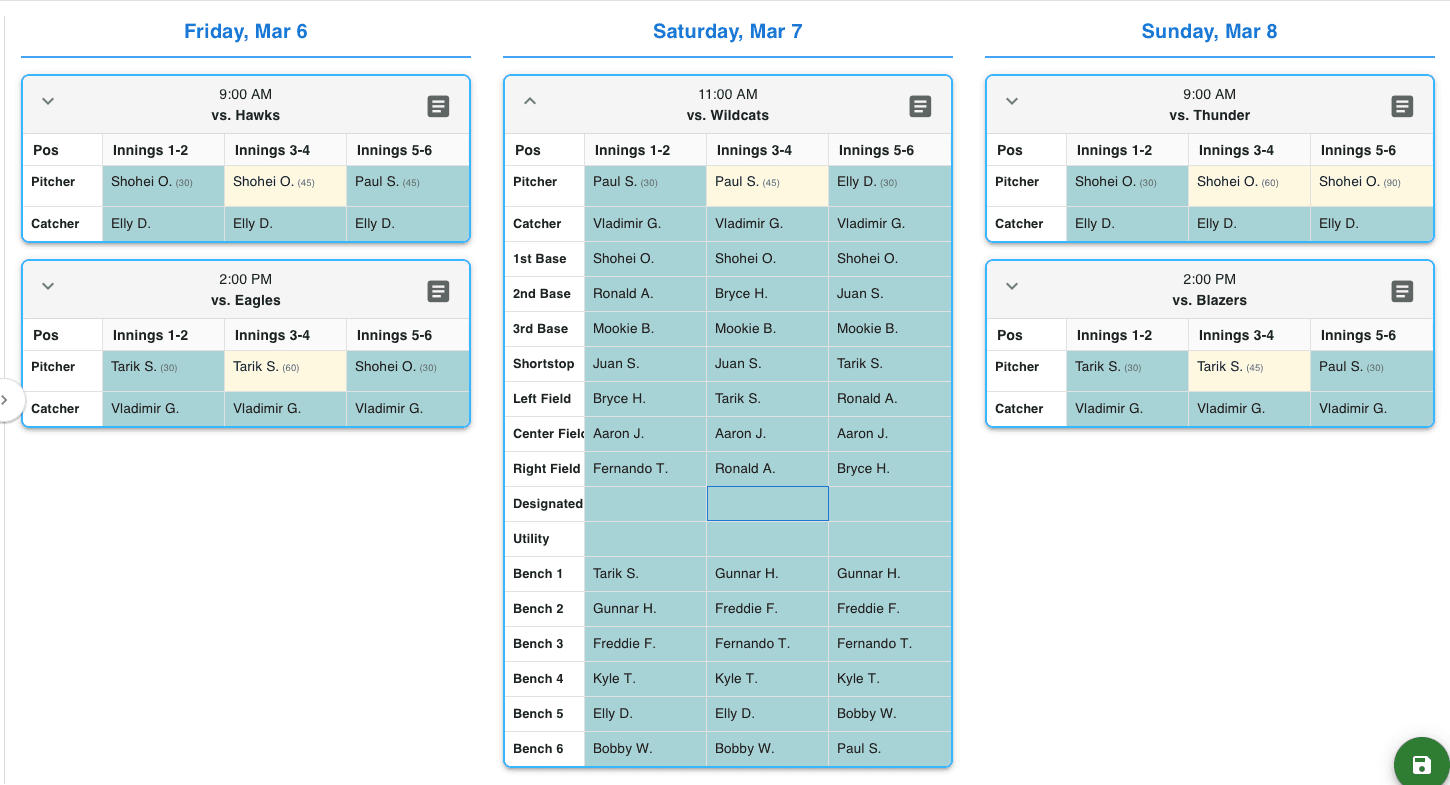
Your catcher catches game one (6 innings). You want him to catch game two. That's 12 innings of catching in one day. Physically, it's brutal on a youth player.
Even if the rules allow it, consider rotating catchers between games. And remember the catcher-to-pitcher rule: if your catcher catches 4+ innings across the day, he can't pitch.
Lineup Adjustments
Fatigue matters at the plate too. If your 3-hole hitter went 3-for-3 in game one but ran the bases hard all morning, he might be gassed by game two's fifth inning. Consider:
- Resting defensive effort by moving fatigued players to less demanding positions (outfield corners)
- Giving your catcher a break at DH or first base in game two
- Using Rizzler's game planning to set different fielding rotations for each game
Frequently Asked Questions
Do pitch counts reset between games on the same day?
No. Pitch counts are cumulative across all games on the same calendar day in Little League and most youth leagues. See the pitch count limits page for details.
Can a pitcher who threw 20 pitches in game one pitch game two?
Not under Little League rules: a pitcher may not appear in a second game on the same day, even after a 20-pitch outing (the 0-rest-day benefit applies to the next calendar day). In leagues that do allow same-day second appearances, the game-two pitches add to the daily total and rest is based on the combined count: 20 in game one plus 40 in game two is 60 pitches, which triggers 3 rest days.
How much rest should players get between games?
Hydrate immediately after game one. Light stretching only; no hard throwing or batting practice between games. The 30-90 minute gap is recovery time, not warmup time.
Does Rizzler handle same-day doubleheaders?
Yes. Rizzler's tournament planner tracks cumulative daily pitch counts across same-day games and shows updated availability between games. The schedule knows which games are on the same day.
Same-day pitch totals are exactly the kind of math that slips between games. Rizzler tracks cumulative counts and calculates rest automatically, and a free account covers your team.
Talk to our team
Want to spend more time coaching and less time with paperwork? Let's talk.
Tell us about your team and we'll show you how to plan games, set lineups, run the schedule, and develop players in one place, so you spend the season coaching instead of chasing admin.
Less admin, more coaching
Plan games, set lineups, and track the season in one place
Keep every family in the loop automatically
Tell us about your program
4 fields · takes 30 seconds
Lands in the same inbox as the Help button · human response only
Read Next
Volleyball Serve Receive: Patterns by Rotation and System
VolleyballHow to Track Attendance for a Youth Sports Team
LearnPitching Stats: Every Mound Stat Explained for Coaches
StatsPlaying Time Fairness Across Your Little League
For LeaguesHow to Start a Volleyball Club
LearnGameChanger Alternatives: 7 Options Compared for 2026
Comparison