Learn
How to Run a Wrestling Tryout: A Coach's Step-by-Step Guide
To run a wrestling tryout, you evaluate every wrestler across a short list of core areas (stance and motion, takedowns, escapes and reversals on the bottom, top control and rides, and conditioning) using a consistent 1-to-5 score per area, then settle the actual starting spots with wrestle-offs inside each weight class. Wrestling is an individual, weight-class sport, so a "tryout" usually means two things at once: deciding who makes the team and deciding who wrestles varsity at each weight. The hard part is rarely the scoring sheet. It is organizing the whole event so the evaluation stays fair, the day runs on time, and you can defend every lineup decision afterward, especially when you are moving a full room of wrestlers through in a single weekend. This guide walks through exactly how to conduct a wrestling tryout from first planning to a finalized lineup, whether you are a youth club placing wrestlers, a school program setting a varsity roster, or a large league putting hundreds of athletes in front of 15 to 20 coaches.
What Skills Should You Evaluate at a Wrestling Tryout?
Evaluate the core areas at a wrestling tryout: stance and motion, takedowns, bottom work (escapes and reversals), top work (control and rides), and conditioning. Then settle starting spots with live wrestle-offs at each weight, where everything comes together under real resistance. Most coaches add an intangibles category (toughness, coachability, and mat awareness) that adjusts a wrestler's overall score up or down. A short, shared list keeps a large evaluation panel focused and consistent.
Here is what evaluators look for in each area and how each is typically assessed at a tryout:
| Skill | What evaluators look for | How it's assessed |
|---|---|---|
| Stance and motion | Low, balanced stance; level changes; good hand fighting and footwork without overextending | Drilling stance and motion, plus what shows up under pressure in live wrestling |
| Takedowns | Clean shots and finishes (single leg, double leg, high crotch), penetration, and setups | Takedown drilling from neutral and live goes from the feet |
| Escapes and reversals | Bottom-position survival and offense: stand-ups, sit-outs, switches, and getting out or to top | Live wrestling starting in the down position |
| Top control and rides | Ability to break down, control, ride legally, and work toward a pin | Live wrestling starting in the top position |
| Conditioning | Output that holds across periods; pace late in a match rather than gassing | Timed runs, situational sparring, and the third period of live goes |
| Intangibles | Toughness, focus, attitude, and mat awareness | Observed throughout; used to add or deduct points from the overall score |
The live goes matter as much as the drilling. Situational sparring (starting from neutral, bottom, and top) and short wrestle-offs reveal who can score and survive under real resistance, which structured drilling alone will not show.
How Do You Score a Wrestling Tryout?
Score each wrestler from 1 to 5 on every area, where 5 is the best, then total the scores to rank wrestlers objectively within and across weights. A simple, shared 1-to-5 scale turns subjective impressions ("he looked tough") into comparable data you can sort, defend, and revisit. Conditioning and intangibles are usually handled as adjustments: add a point or two for the wrestlers who push the pace and compete, and deduct for those who fade or coast.
Starting spots, though, come down to head-to-head wrestle-offs at each weight, because that is the fairest way to settle who wrestles varsity. Many programs use a rule like beating the current starter twice to take the spot. The rubric scores tell you the overall picture of the room; the wrestle-offs decide the lineup.
Two rules make the scores trustworthy at scale. First, align your evaluators on what each number means before the tryout, so a "3" takedown and a "4" takedown mean the same thing to every coach in the room. With 15 to 20 evaluators grading the same wrestlers, this calibration is what keeps scores comparable. Second, score immediately after each go while it is fresh, and add a short note next to the number. "Strong on top, gives up easy escapes" tells you far more in a week than a bare "3."
How to Set Up Wrestling Tryout Stations at Scale
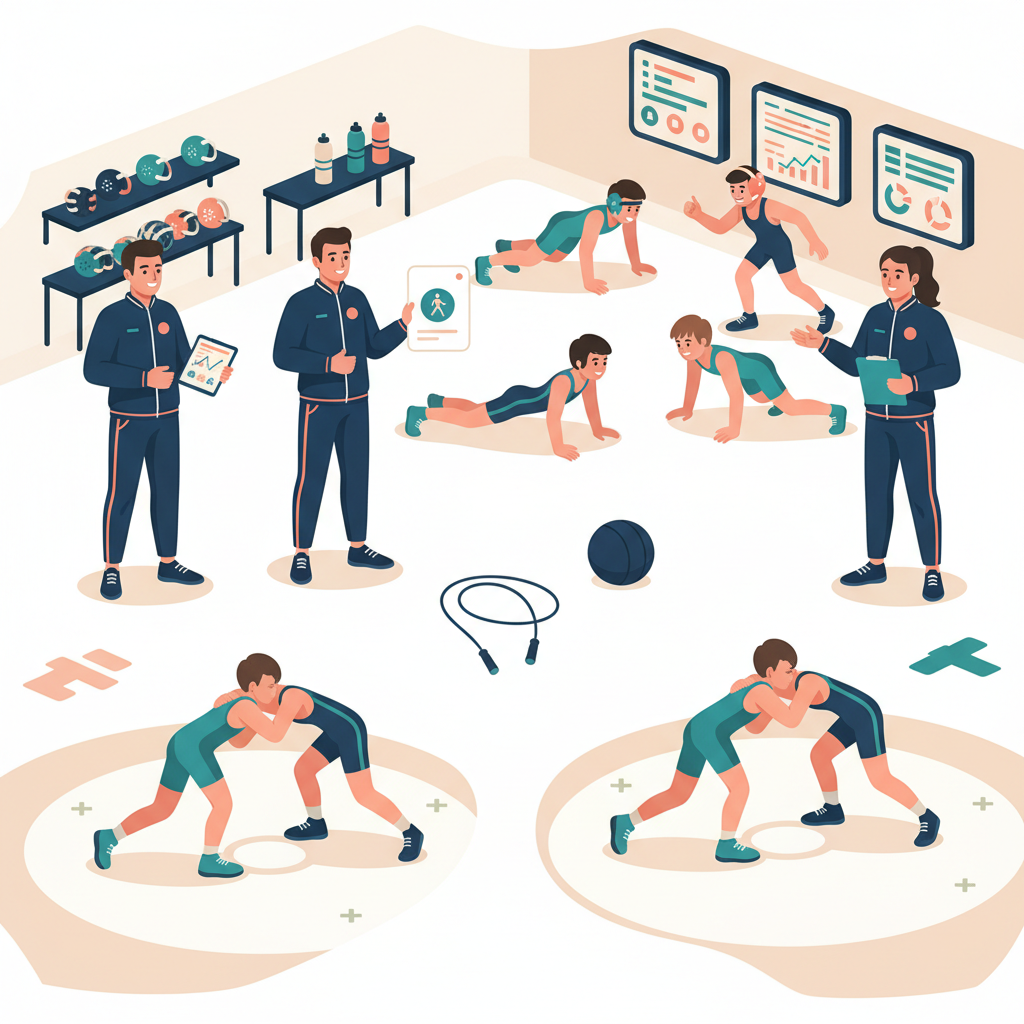
Set up one station per area and rotate small groups through them so the mats stay busy and every wrestler gets identical reps. Use mat sections or markers to define each station: stance and motion drilling, a takedown station, a bottom-work station, a top-work station, a conditioning lane, and a roped-off mat for live wrestle-offs by weight.
How you staff those stations depends on size. At a small tryout, one coach can grade a whole area. At scale, with hundreds of wrestlers and 15 to 20 coaches, you do the opposite: put several evaluators at each station so a large group keeps moving, and have every coach score the same drill against the shared rubric. Some programs run it in panels, splitting evaluators across stations, while others move all coaches to one mat at a time so everyone grades the same go together, which is common for the conditioning test and the wrestle-offs. Either way, the goal is multiple independent scores per wrestler, which you average for a more reliable result than any single grader could give. Keep a staffed check-in and weigh-in table at the entrance so you always know who has arrived, who is still expected, and who falls into which weight class.
Wrestling Tryout Timeline: From Planning to Finalized Lineup
Plan to start two to three weeks before tryout day, then move through registration, check-in and weigh-in, evaluation, review, and lineup. Here is the full end-to-end checklist for hosting the event:
Two to three weeks before: Planning
- Lock the date and room or facility; reserve the mats
- Decide weight classes, roster size, and varsity and junior varsity spots
- Build (or reuse) your evaluation form with the areas above
- Recruit and brief evaluators; align all 15 to 20 coaches on the 1-to-5 standards
- Open online registration so you have a confirmed wrestler count
Registration
- Collect each wrestler's name, age or grade, expected weight class, and contact info
- Assign every wrestler a tryout number so evaluators score by number, not by name, which keeps scoring objective even with hundreds of athletes
- Send a confirmation with arrival time, location, and what to bring
Tryout day: Check-in and weigh-in
- Check wrestlers in against your registration list and hand out numbers
- Weigh wrestlers in to sort them into weight classes
- Brief them on the station flow and the wrestle-off format
Tryout day: Evaluation
- Run wrestlers through each drilling station; evaluators score 1 to 5 and add notes in real time
- Run the conditioning test and situational live wrestling
- Hold wrestle-offs by weight to decide head-to-head spots
- For multi-day tryouts, repeat key goes on day two so a single off-day doesn't sink a wrestler
After the tryout: Review and decide
- Combine every evaluator's scores into one ranked list within each weight
- Discuss bubble wrestlers as a staff, using notes and wrestle-off results alongside the numbers
- Finalize the team and the varsity lineup at each weight
Lineup: Confirm, communicate, and finalize
- Tell selected wrestlers their roster spot and weight with a clear next step
- Explain how in-season wrestle-offs can change starting spots
- Send respectful, timely notice to wrestlers who weren't selected
- Confirm the final lineup and communicate next steps (practice schedule, fees)
Run Your Entire Wrestling Tryout with Rizzler Sports
A tryout at scale is a logistics problem before it is a wrestling problem. Hundreds of registrations, weigh-ins and check-ins, a stack of evaluation sheets for every coach, then the follow-up: confirming roster spots, tracking who accepted, and managing wrestle-off results by weight. Rizzler Sports handles all of it in one place, which saves coaches and administrators hours of work per tryout. Wrestlers register online, coaches score evaluations on a phone or tablet at every station, results rank automatically, and you send and track lineup decisions without a single spreadsheet or group text.
Running a larger program, a full club, a school district, or a regional league? We will set your tryout up end to end and show you how much staff time it saves.
Talk to our team
Running a tryout at scale? Let's talk.
Tell us about your club, league, or school and we'll come back to you within one business day with a walkthrough of how much staff time Rizzler Sports saves by running your tryout end to end: registration, check-in, evaluations, invites, and offers in one place.
Cut tryout admin from days to minutes
Online registration and check-in for hundreds of players
Evaluate, rank, invite, and track offers in one place
Tell us about your program
6 fields · takes 60 seconds
Lands in the same inbox as the Help button · human response only
Frequently Asked Questions
Does wrestling really have tryouts?
Yes, though it works differently from team sports. Many programs do not cut, so the tryout is really about evaluating the room and then settling starting spots with wrestle-offs inside each weight class. Whoever wins the wrestle-off earns the varsity spot, and many programs let challengers take a spot by beating the starter twice.
How long should a wrestling tryout be?
Most wrestling tryouts run two to three hours, or two sessions across two days for competitive programs, because conditioning and live wrestling take time and you want to see athletes when they are tired. Build in time for check-in and weigh-in before the clock starts.
How do you staff coaches at a large wrestling tryout?
At scale, do not assign one coach per area. With hundreds of wrestlers and 15 to 20 coaches, put multiple evaluators at each station, or move all coaches through one mat at a time, and have everyone score the same go against a shared 1-to-5 rubric. Averaging several independent scores per wrestler is more reliable, and far faster, than a single grader working through a full room.
What should wrestlers bring to a tryout?
Wrestling shoes, singlet or practice gear, headgear, mouthguard if needed, and water. Tell wrestlers to arrive early enough to check in, weigh in, and warm up before evaluations begin.
How do weight classes affect the tryout?
Weight classes drive the wrestle-offs: you compare and match wrestlers within the same class so the contest is about technique and conditioning, not size. Weigh wrestlers in at check-in to sort them, and remember that in dual meets you may need specific wrestlers at certain weights to fill the lineup.
Read Next
AI Stats Analysis — Turn Game Data into Coaching Insights
FeaturesBaseball Statistics: The Complete Reference for Coaches
StatsRizzler for Little League Head Coaches
For CoachesTeamSnap Alternatives: 7 Options Compared for 2026
ComparisonHow to Run a Flag Football Tryout: A Coach's Step-by-Step Guide
LearnHow to Run a Swim Team Tryout: A Coach's Step-by-Step Guide
Learn